Finding a Trading Strategy
There are countless trading strategies available for all markets. Whether you trade stocks, forex, futures or CFDs, there are one or more trading strategies that will fit your risk tolerance and trading style.
But before you attempt to use any of the available trading strategies, it is an absolute MUST that you first know and understand your own personal risk tolerance.
What exactly would put you out of the trading business in the event things went against you? How much risk can you handle emotionally, psychologically, and financially? What would completely demoralize you and cause you to give up trading? If you haven’t figured that out, then stop right now, get your thoughts together, and make that all-important decision before you attempt to use any of the possible trading strategies.
Once you have determined your personal risk tolerance, you are ready for the next step ─ matching the strategy, market, and time frame to your risk tolerance. You must discard any trading strategy that does not match up.
Let’s look at an example of matching trading strategies to your personal risk tolerance:Let’s assume you want to make a trade in gold. You can make this trade in the futures market via an ETF, in the stock market, or using a CFD. The CFD could possibly be used to trade either futures or shares in an ETF.
After assessing your personal risk tolerance, you decide that the most you can handle is a $1,000 loss.
In futures, if you trade 5 contracts and lose $200 per contract, it would amount to a $1,000 loss overall. Four lots would equal $800. Two lots would equal $400. If you are trading something other than futures, decide how many shares it would take to equal the amount you are willing to lose if the price per share should happen to drop.
Next, let’s take one strategy out of the many trading strategies available. One strategy available to us is something we call “gimmee bars.” Gimmee bars have an overall yield of 80% winning trades if traded properly. A gimmee bar is a reversal bar that touches or exceeds two Standard Deviations from a moving average of the Closes. A reversal bar is one that opens and closes opposite to the direction prices were moving.
Using a 20-bar moving average and two-Standard Deviations, we can set up a study called “Bollinger Bands” to determine an entry point and the amount of risk we would have to take.
The chart we’re looking at is a daily chart of gold on April 12. The arrow on the chart points to a Gimmee Bar. Gimmee Bars are one of the oldest and most reliable trading strategies around. Prices had been rising, reached the upper Bollinger Band, and had reversed direction by closing lower than it had opened.
How do you calculate the risk?
The upper band was at 1475.70. The moving average was at 1433.10. The difference was 42.7 points. A point in gold futures is $100. The risk was $4,270 of volatility between the moving average and the upper Bollinger Band. As a rule, we risk only half the volatility when making a trade. Even so, $2,135 is too much to risk if your risk tolerance is $1,000. The risk on the daily gold chart is too great. We cannot even handle one contract. We are unable to match our risk tolerance to the risk in the market.We now have to make a choice:
- Find another market to trade using this trading strategy.
- Move to a lower time frame in gold if we want to use this strategy.
- Use one of the other trading strategies that may be available to us.
Let’s say in this example we move to a lower time frame. We’ll try to find the same thing happening on or closely following April 12 on a 60-minute chart.
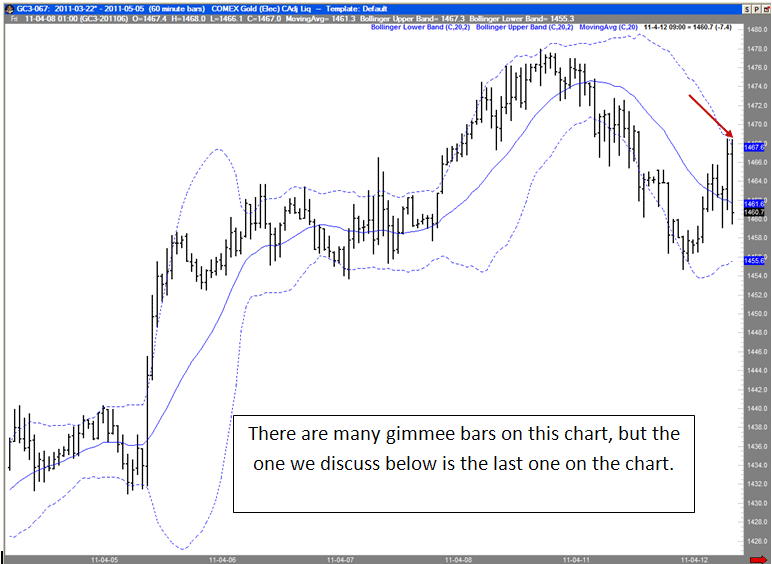
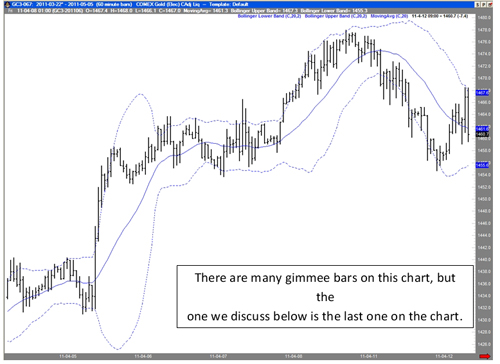
At 9AM on April 12, prices touch the upper Bollinger Band and then reverse.
The upper band is at 1467.60, and the moving average is at 1461.60. The volatility between the upper band and the moving average is 6 points, or $600. Half of that amount is $300. The strategy calls for us to sell the low of the gimmee bar. We can sell 3 contracts, risking $300 per contract, and still be within our personal risk tolerance. We have successfully matched our personal risk tolerance to the risk in the market. At the same time, we have position-sized the trade to 3 contracts, risking $900 in all.
Any one of the many trading strategies available to traders can be used in following the principle of matching personal risk tolerance to the amount of risk in the market.These trading educational articles are provided by Joe Ross and Trading Educators, Inc.
© Copyright by Joe Ross. Re-transmission or reproduction of any part of this material is strictly prohibited without the prior written consent of Trading Educators, Inc.
GO BACK TO TOP
trading-books.com

 |